© Franz Kerschbaum

Turmfalkenprojekt Wien

The Vienna Kestrel Project studies how Eurasian kestrels adapt to life in Austria’s capital. Since 2010, citizen scientists help map nests and document breeding behaviour, contributing valuable data to urban raptor research.
The Vienna Kestrel Project is organised in a collaboration between the University of Vienna and the Natural History Museum Vienna, and has been investigating the ecology and urban adaptation of kestrels in urban systems since 2010. As the most common raptor in the city, kestrels nest in building cavities and other urban structures, making their breeding activities visible from streets and apartments across Vienna. The project relies on enthusiastic citizen scientists to report kestrel nest locations and breeding observations - especially dates of egg laying, hatching, and fledging - which helps researchers build a comprehensive nest database and track population dynamics. While trained staff and students conduct the handling of birds for ringing and sampling, community members play a key role by observing and documenting the kestrels’ breeding cycles, sharing photos, and increasing public awareness of urban wildlife. In recent years, the Vienna Kestrel Project has expanded to include a high-resolution tracking component as part of ICARUS Birds led by the Max Planck Institute. Using lightweight ICARUS tracking devices that transmit location-time data via the Sigfox antenna network, we can now follow individual kestrels far beyond the breeding season. This allows us to uncover migration routes, post-fledging dispersal, habitat use, hunting behaviour, and causes of mortality in unprecedented detail. By combining long-term citizen science observations with cutting-edge tracking technology, the project provides new insights into how these iconic city dwellers move through, exploit, and survive in increasingly human-dominated landscapes.
Team Members

A/Prof Dr Petra Sumasgutner
Principal investigator

Monica Sageder
Field assistant
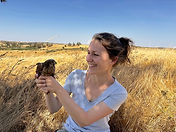
Sarah Guttenberger
Field assistant

PD Dr Anita Gamauf (1962-2018)
Curator of birds, Natural History Museum Vienna
Collaboration Partners

Project Gallery
Project Gallery


Sumasgutner P, Nilles T, Hykollari A, de Chapa MM, Isaksson C, Hochleitner L, Renner S & Fusani L (2023) Integument colouration and circulating carotenoids in relation to urbanisation in Eurasian kestrels (Falco tinnunculus). The Science of Nature 110: 48. Doi: 10.1007/s00114-023-01874-5
Wemer L, Hegemann A, Isaksson C, Nebel C, Kleindorfer S, Gamauf A, Adrion M, Sumasgutner P (2021): Reduced ectoparasite load, body mass and blood haemolysis in Eurasian kestrels (Falco tinnunculus) along an urban-rural gradient. The Science of Nature | Naturwissenschaften 108: 42. Doi: 10.1007/s00114-021-01745-x
Huchler K, Gamauf A, Schulze C, Sumasgutner P (2020): Shifting breeding phenology in Eurasian kestrels Falco tinnunculus: Effects of weather and urbanisation. Frontiers in Ecology and Evolution 8: 247. Doi: 10.3389/fevo.2020.00247
Sumasgutner P, Adriøn M, Gamauf A (2018): Carotenoid colouration and health status of urban kestrels (Falco tinnunculus). PlosOne 13: e0191956. Doi: 10.1371/journal.pone.0191956
Sumasgutner P, Schulze CH, Krenn HW, Gamauf A (2014): Conservation related conflicts in the nest-site selection of the Eurasian Kestrel (Falco tinnunculus) and the distribution of its avian prey. Landscape and Urban Planning 127: 94–103. Doi: 10.1016/j.landurbplan.2014.03.009
Sumasgutner P, Nemeth E, Tebb G, Krenn HW, Gamauf A (2014): Hard times in the city - attractive nest sites but insufficient food supply lead to low reproduction rates in a bird of prey. Frontiers in Zoology 11: 48. Doi: 10.1186/1742-9994-11-48